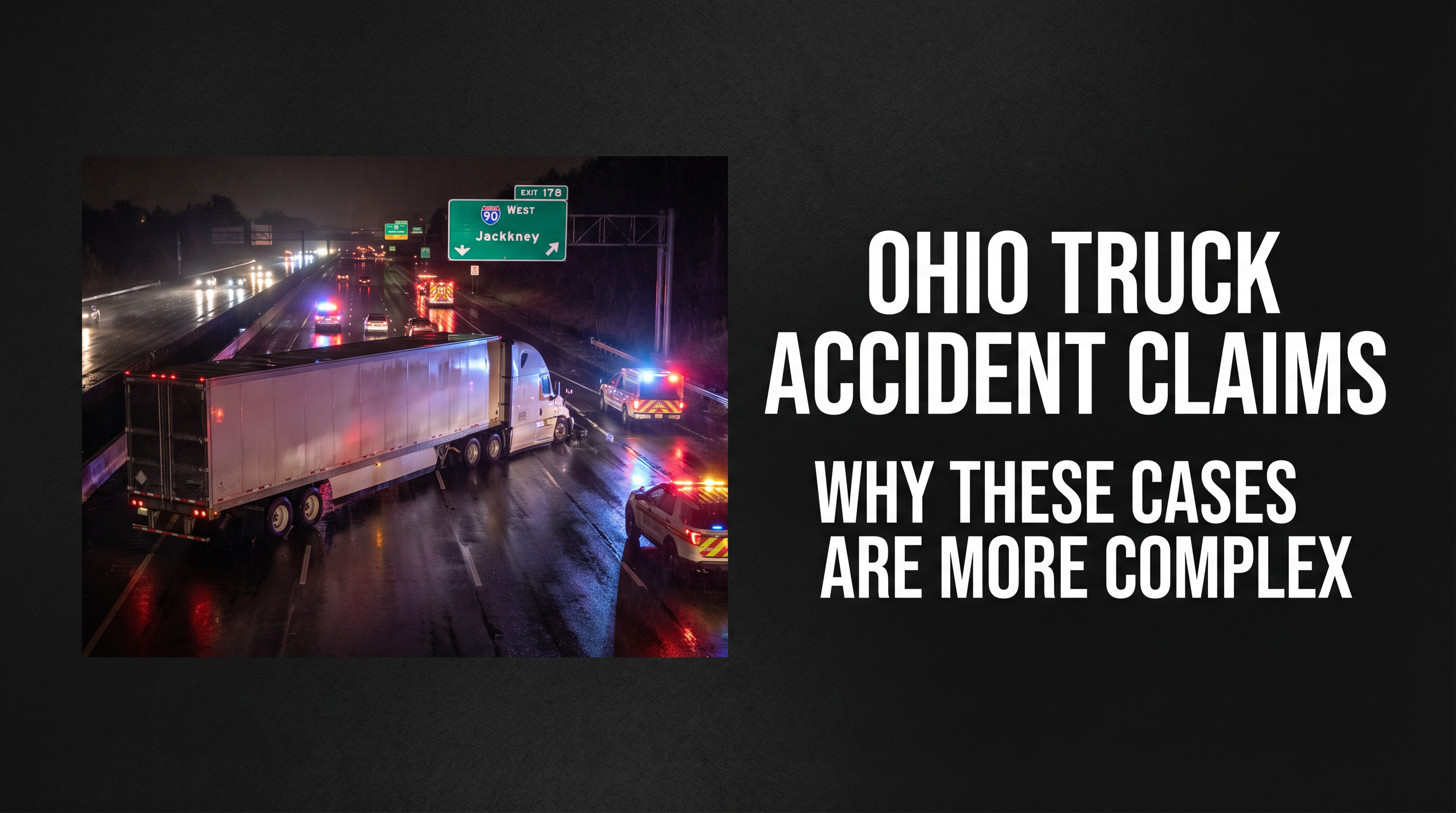
Accidents involving commercial semi-trucks, tractor-trailers, and 18-wheelers are categorically different from standard passenger car collisions. A fully loaded commercial truck can weigh up to 80,000 pounds—roughly 20 times the weight of an average car. When these massive vehicles collide with passenger cars on Ohio highways like I-90, I-77, or the Ohio Turnpike, the results are often catastrophic or fatal. Navigating a truck accident claim requires specialized legal knowledge, as these cases involve complex federal regulations, multiple liable parties, and aggressive corporate defense teams.
The Complexity of Truck Accident Liability
In a typical car accident, liability usually rests solely with the at-fault driver. In a commercial truck accident, multiple parties may share legal and financial responsibility for the crash. Identifying all liable parties is crucial for maximizing compensation, as commercial policies carry much higher limits (often $1 million or more).
Potential defendants in an Ohio truck accident case include:
- The Truck Driver: For negligence such as speeding, distracted driving, driving under the influence, or driving while fatigued.
- The Trucking Company (Motor Carrier): Under the doctrine of respondeat superior, employers are liable for the negligence of their employees. The company may also be directly liable for negligent hiring, inadequate training, or forcing drivers to meet unrealistic delivery schedules.
- The Owner of the Truck/Trailer: If the cab and trailer are owned by different entities, both may be liable if poor maintenance contributed to the crash.
- The Freight Loader/Shipper: If the cargo was improperly loaded, overloaded, or inadequately secured, causing the truck to roll over or jackknife, the shipping company may be liable.
- The Manufacturer: If a defective part, such as faulty brakes or a blown tire, caused the accident, a product liability claim can be pursued against the manufacturer.
Federal Motor Carrier Safety Regulations (FMCSR)
Commercial trucking is a highly regulated industry. The Federal Motor Carrier Safety Administration (FMCSA) imposes strict rules on drivers and trucking companies. Violations of these regulations serve as powerful evidence of negligence in a civil lawsuit.
Key regulations frequently involved in truck accident claims include:
- Hours of Service (HOS): To combat driver fatigue, federal law strictly limits how many hours a driver can operate a truck without a rest break. Drivers must maintain detailed logbooks (now mostly electronic) tracking their hours. Falsifying these logs is a common and serious violation.
- Maintenance and Inspection: Trucking companies must perform regular inspections and maintenance on their fleets. Drivers must also perform pre-trip and post-trip inspections. Failure to replace worn brakes or bald tires is a frequent cause of catastrophic rear-end collisions.
- Weight Limits: Overloaded trucks require significantly longer stopping distances and are highly susceptible to rollovers.
- Drug and Alcohol Testing: Commercial drivers are subject to strict random testing and mandatory post-accident testing.
The Importance of Rapid Evidence Preservation
Trucking companies have rapid response teams—investigators, defense attorneys, and accident reconstructionists—who are dispatched to the scene of a serious crash within hours. Their job is to mitigate the company's liability and control the narrative from day one.
To level the playing field, injured victims must hire an attorney immediately to preserve critical evidence before it "disappears." This is done by sending a formal spoliation letter to the trucking company, legally demanding the preservation of:
- The Black Box (ECM): The truck's Electronic Control Module records crucial data in the seconds leading up to the crash, including speed, braking, steering input, and engine RPM.
- Electronic Logging Devices (ELD): To prove Hours of Service violations and driver fatigue.
- Dashcam Footage: Both inward-facing (showing driver distraction) and outward-facing cameras.
- Maintenance Records and Driver Qualification Files: To prove negligent hiring or poor vehicle upkeep.
Catastrophic Injuries and High-Stakes Litigation
Because of the sheer force involved, truck accidents frequently result in traumatic brain injuries (TBI), spinal cord injuries, paralysis, amputations, and wrongful death. These catastrophic injuries require lifetime medical care and result in massive economic losses.
Trucking companies and their insurers fight these high-value claims aggressively. They will attempt to shift blame onto the victim, argue that the injuries are not as severe as claimed, or use complex corporate structures to shield assets. Defeating these tactics requires a law firm with the resources to hire top-tier medical experts, economists, and accident reconstruction engineers.
Demand Justice After an Ohio Truck Accident
If you or a loved one has been severely injured in a collision with a commercial truck in Cuyahoga County, you are facing a well-funded corporate defense machine. You need an advocate who will not back down.
Contact Ryan Injury Attorneys immediately for a free consultation. We have the experience and resources to investigate complex trucking accidents, hold all negligent parties accountable, and secure the life-altering compensation you need.
Frequently Asked Questions
Why do I need a lawyer specifically experienced in truck accidents?
Truck accident cases are not just big car accident cases. They involve federal regulations, complex corporate liability structures, specialized electronic evidence (black boxes), and aggressive defense tactics. An attorney who only handles standard car accidents may miss critical evidence or fail to identify all liable parties, costing you millions in potential compensation.
How long do I have to sue a trucking company in Ohio?
Generally, the statute of limitations for personal injury in Ohio is two years from the date of the accident (O.R.C. § 2305.10). However, you must act much faster than that. Critical evidence like black box data and dashcam footage can be legally overwritten or destroyed within weeks if your attorney does not send a preservation demand.
What if the truck driver is an independent contractor?
Trucking companies often classify drivers as "independent contractors" to avoid liability for their negligence. However, under federal regulations, if a motor carrier leases a truck and driver and operates under its own DOT number, the carrier is generally held legally responsible for the driver's actions, regardless of their employment classification.
What is a "spoliation of evidence" letter?
A spoliation letter is a formal legal document sent by your attorney to the trucking company immediately after a crash. It demands that they preserve all evidence related to the accident, including the truck itself, black box data, logbooks, and driver records. If they destroy evidence after receiving this letter, the court can impose severe sanctions against them.
Can I sue if a truck's blown tire caused my accident?
Yes. If a truck tire blows out and causes a crash, liability may fall on the trucking company for failing to inspect and replace worn tires, the maintenance company that serviced the truck, or the tire manufacturer if the tire was defective. Your attorney will investigate to determine the root cause of the blowout.