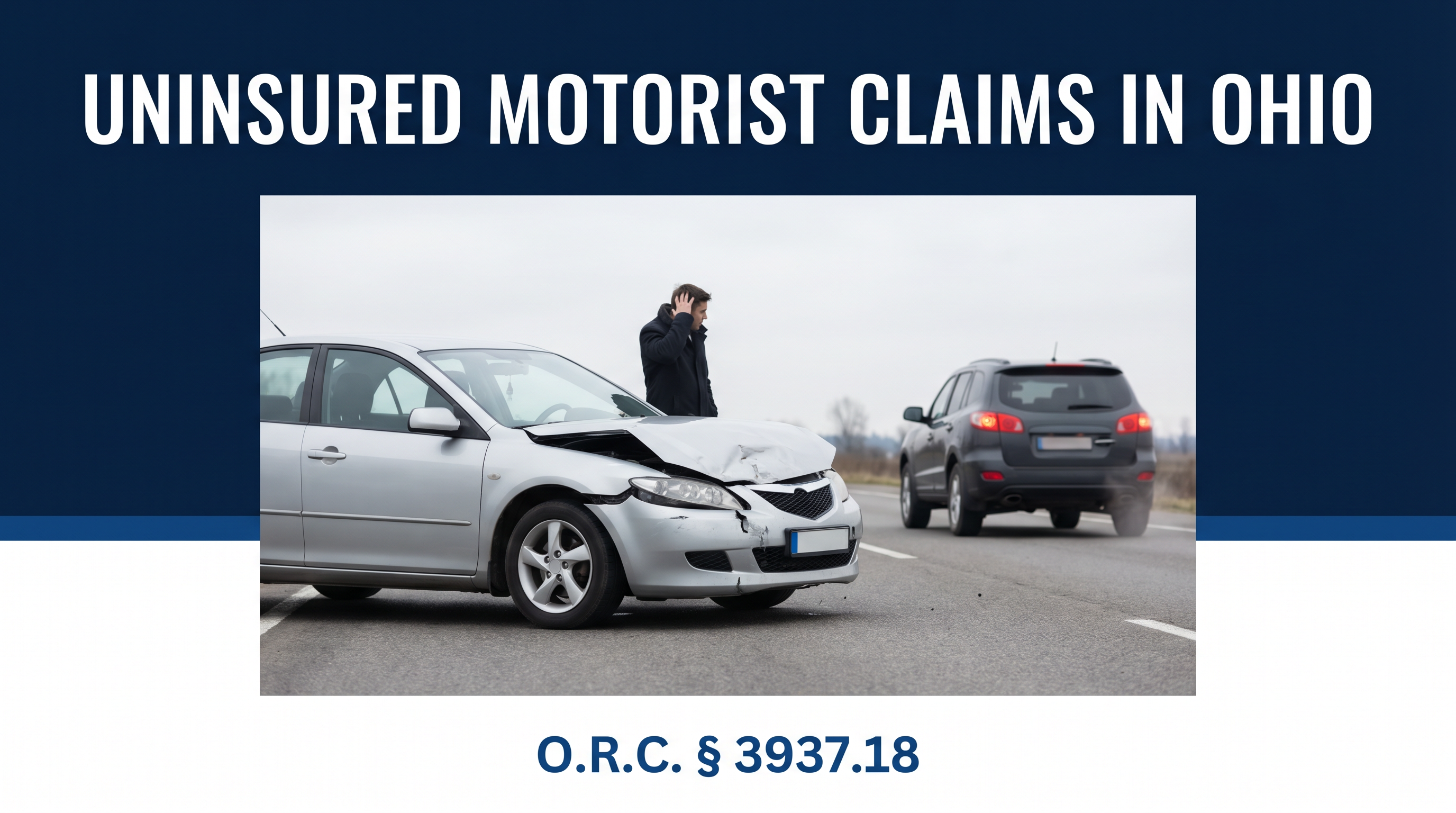
Being involved in a car accident is stressful enough, but the anxiety multiplies exponentially when you discover the driver who hit you has no insurance. According to the Insurance Research Council, approximately 1 in 8 drivers on Ohio roads are completely uninsured. Thousands more carry only the state minimum liability limits, which are often grossly insufficient to cover the costs of a serious injury. In these situations, your financial recovery depends entirely on your own Uninsured/Underinsured Motorist (UM/UIM) coverage.
What is UM/UIM Coverage in Ohio?
Uninsured/Underinsured Motorist coverage is an optional addition to your Ohio auto insurance policy, governed by Ohio Revised Code Section 3937.18. While Ohio law requires all drivers to carry minimum liability insurance ($25,000 per person / $50,000 per accident), it does not require drivers to purchase UM/UIM coverage. However, insurance companies are required to offer it to you when you purchase a policy.
This coverage acts as a safety net. If you are injured by a driver who has no insurance, or whose insurance limits are too low to cover your damages, your own insurance company steps into the shoes of the at-fault driver to compensate you.
How Uninsured Motorist (UM) Coverage Works
UM coverage applies when the at-fault driver has absolutely no auto insurance. It also applies in hit-and-run accidents where the at-fault driver cannot be identified. If you have $100,000 in UM coverage and suffer $80,000 in damages from an uninsured driver, your insurance company will pay the full $80,000.
How Underinsured Motorist (UIM) Coverage Works
UIM coverage is slightly more complex. It applies when the at-fault driver has insurance, but their policy limits are lower than your damages AND lower than your UIM limits. Ohio is a "limits-to-limits" state, meaning your UIM coverage does not stack on top of the at-fault driver's coverage; it merely fills the gap.
For example: You suffer $100,000 in injuries. The at-fault driver has the state minimum $25,000 policy. You have a $100,000 UIM policy. You will collect the $25,000 from the at-fault driver's insurance. Then, you can turn to your own UIM policy for the remaining $75,000. Your total recovery is capped at your $100,000 UIM limit.
Crucially, if your UIM limits are equal to or lower than the at-fault driver's liability limits, you cannot collect any UIM benefits, regardless of how high your medical bills are.
What Does UM/UIM Cover?
UM/UIM coverage compensates you for the same damages you would have recovered from the at-fault driver's liability policy, including:
- Past and future medical expenses
- Lost wages and diminished earning capacity
- Pain and suffering
- Loss of consortium (for your spouse)
Note that UM/UIM bodily injury coverage does not pay for damage to your vehicle. That is covered by Uninsured Motorist Property Damage (UMPD) or your standard collision coverage.
The Adversarial Nature of UM/UIM Claims
Many people mistakenly believe that because they are dealing with their own insurance company, the process will be easy and fair. This is a dangerous assumption. When you file a UM/UIM claim, your insurance company essentially becomes your adversary. Their goal is to pay you as little as possible, just as the at-fault driver's insurance company would.
Your own insurer may dispute the severity of your injuries, argue that you were partially at fault for the crash, or demand independent medical examinations to undermine your doctor's diagnosis. You need an attorney to negotiate these claims just as aggressively as a third-party claim.
Strict Notice and Consent Requirements
UM/UIM policies contain strict contractual requirements that must be followed precisely. If you fail to comply, your insurance company can deny your claim entirely.
- Prompt Notice: You must notify your insurer of the accident and your intent to file a UM/UIM claim promptly.
- Consent to Settle: If you are dealing with an underinsured driver, you absolutely must obtain written consent from your own insurance company before accepting a settlement from the at-fault driver. If you settle with the at-fault driver without your insurer's permission, you destroy your insurer's subrogation rights, and they will deny your UIM claim.
Don't Fight Your Insurance Company Alone
UM/UIM claims involve complex contract law and strict procedural deadlines. A single misstep, such as signing a release without permission, can cost you tens of thousands of dollars in coverage you paid for.
If you were hit by an uninsured or underinsured driver in Cleveland, contact Ryan Injury Attorneys. We will review your policy, handle all communication with your insurer, and fight to maximize your recovery. Call today for a free consultation.
Frequently Asked Questions
Will filing a UM/UIM claim make my insurance rates go up?
Under Ohio law, an insurance company generally cannot raise your premiums solely because you filed a UM/UIM claim for an accident that was not your fault. You pay premiums specifically for this protection; you should not be penalized for using it.
Can I use UM coverage for a hit-and-run accident?
Yes. In Ohio, a hit-and-run driver is treated as an uninsured motorist. However, your policy likely requires "independent corroborative evidence" that another vehicle caused the crash (such as a witness or physical damage showing contact) to prevent fraudulent claims where a driver simply ran off the road.
What is "stacking" and is it allowed in Ohio?
Stacking refers to combining the UM/UIM limits of multiple vehicles on the same policy to increase the total coverage available. Ohio law (O.R.C. § 3937.18) explicitly allows insurance companies to include anti-stacking language in their policies, and virtually all standard auto policies in Ohio prohibit stacking.
How much UM/UIM coverage should I carry?
You should carry as much UM/UIM coverage as you can afford, ideally matching your liability limits. The state minimum of $25,000 is rarely enough to cover a serious injury involving surgery or a hospital stay. We recommend a minimum of $100,000/$300,000 in UM/UIM coverage.
Do I need a lawyer for a UM/UIM claim?
Yes. Because your insurance company acts as the defense in a UM/UIM claim, their interests are directly opposed to yours. An attorney will ensure you meet all contractual notice requirements, properly value your damages, and negotiate aggressively to secure the full limits of your policy.